Independent project: Model diagnostics platform
ML Failure Lab: where a model fails and why
Upload a classifier's or regressor's predictions and see where it fails, why the headline metrics mislead, and what to test next: failure slices with confidence intervals, a clickable confusion matrix, calibration, a cost-aware threshold simulator, run comparison and drift monitoring.
What it is
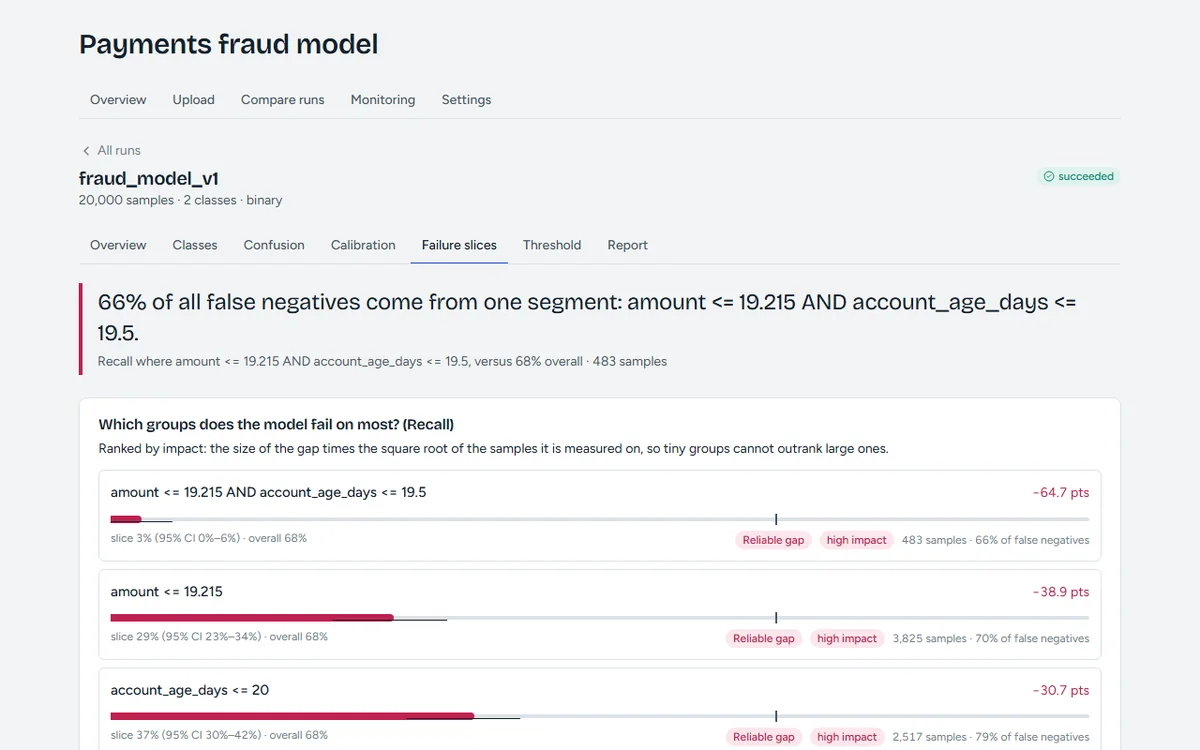
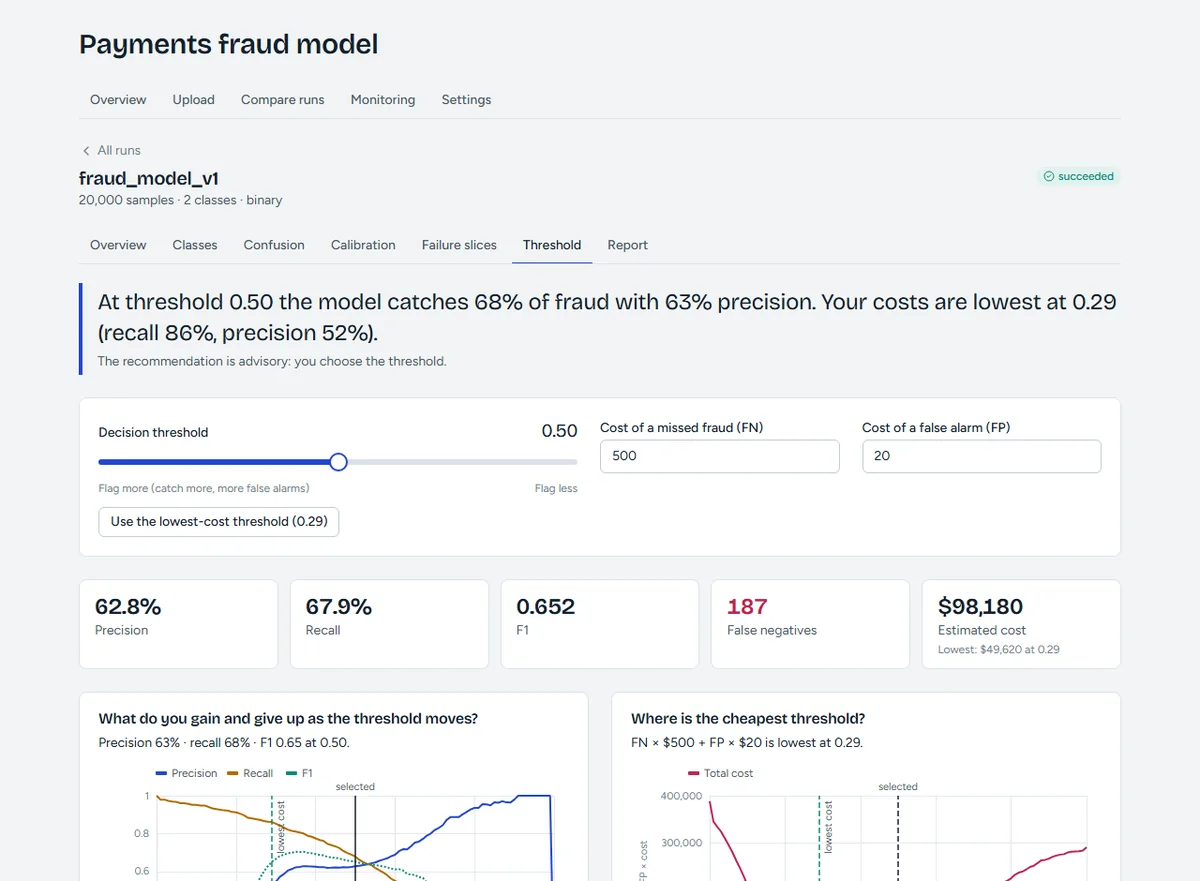
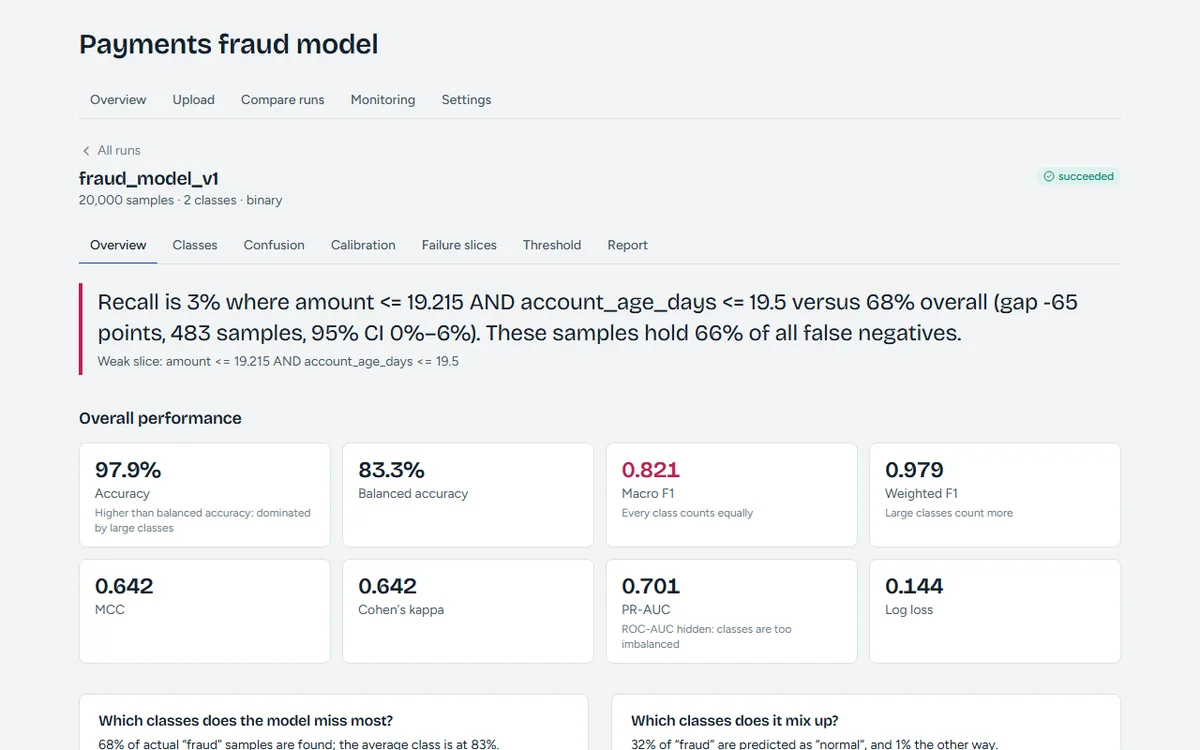
A model can report 98% accuracy while missing most of the cases that matter. ML Failure Lab is built to find that gap: in the bundled fraud demo, recall for the fraud class is 68%, 66% of the false negatives come from one segment of small transactions on young accounts, and lowering the threshold from 0.50 to 0.29 lifts recall to 86% while precision falls to 52%. The demo data is synthetic and the numbers come from the real analysis.
It covers binary, multiclass, multilabel and regression problems, with accounts, email verification and password reset around it. The test suite has 299 engine, API and worker tests. On one machine it analysed 1 million rows in about 5 seconds, and a job whose worker was killed was recovered on the next attempt. It is not deployed: the Compose stack is the verified way to run it, and email was only checked against a local mail catcher.
My part
I designed and built the analysis engine, the API, the background workers and the web app.
Independent project. It runs through Docker Compose and is not deployed.
Stack
- FastAPI
- Celery
- PostgreSQL
- Redis
- MinIO
- Next.js 16
- Python
- Ollama
- Docker Compose
What is inside
A Next.js website, a FastAPI API and Celery workers around a pure analysis library, with PostgreSQL, Redis and S3-compatible storage.
01
Upload and validation
CSV or Parquet files are mapped to columns and validated, with human-readable errors that say how to fix the file.
02
Analysis core
A standalone package computes class metrics, calibration, failure slices (categorical, numeric bins and tree-found interactions), thresholds and run comparisons, tested for parity against scikit-learn and with property-based tests.
03
Background jobs
Workers run analyses with heartbeats, so a job whose worker was killed is recovered on the next attempt.
04
Monitoring
Drift rules and alerts work with delayed labels, optionally cross-checked against Evidently.
05
Guarded AI diagnostics
A local Ollama model phrases findings, and every statement must cite real evidence ids and only use numbers present in the evidence. Statements that fail are dropped and listed as rejected; deterministic templates are the fallback.