Independent project: Simulation and learning tool
SystemForge: a system-design laboratory
An interactive way to learn system design: instead of reading about caching, you flush the cache and watch the database fall over. A simulation engine drives 40 system labs, an architecture canvas, a code playground and scored challenges. It has helped over 10,000 users learn system design.
What it is
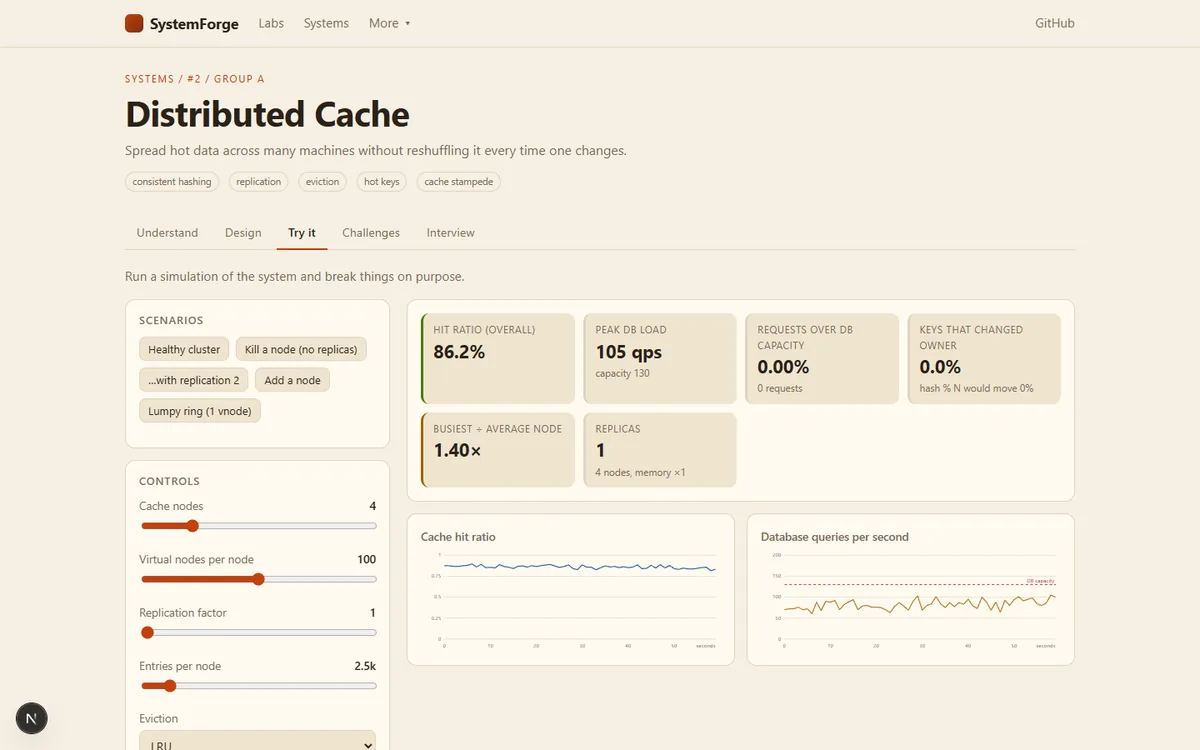
System-design material is usually diagrams and advice. SystemForge makes it testable: each topic follows one loop of theory, manipulate, observe metrics, break it, and compare trade-offs.
Everything runs on one deterministic simulator, so the same inputs always give the same numbers. Forty systems, from a URL shortener to a stock exchange, are described as data on top of that engine rather than as forty separate pages.
My part
I designed and built the simulation engine, the 40 system labs, the canvas, the playground and the web app.
Independent project.
Stack
- Next.js 16
- React 19
- TypeScript
- Vitest
- Discrete-event simulation
- Docker Compose
What is inside
A TypeScript workspace: a pure engine with no framework, and a Next.js app on top.
01
Simulation engine
A discrete-event simulator with traffic models, caches, load balancers, consistent hashing, rate limiters, queues and sharding. Heavier pieces are real algorithms: a Raft implementation, collaborative-editing OT and CRDT, an order book, A*, and a max-flow matcher.
02
Systems as data
Each of the 40 systems is a spec (requirements, estimation, reference architecture, failure scenarios) plus a demo with controls, presets and a pure function that returns metrics and charts.
03
Challenges
Each demo has scored challenges that begin failing a goal, with a hint and a documented solution that passes every goal.
04
Tools
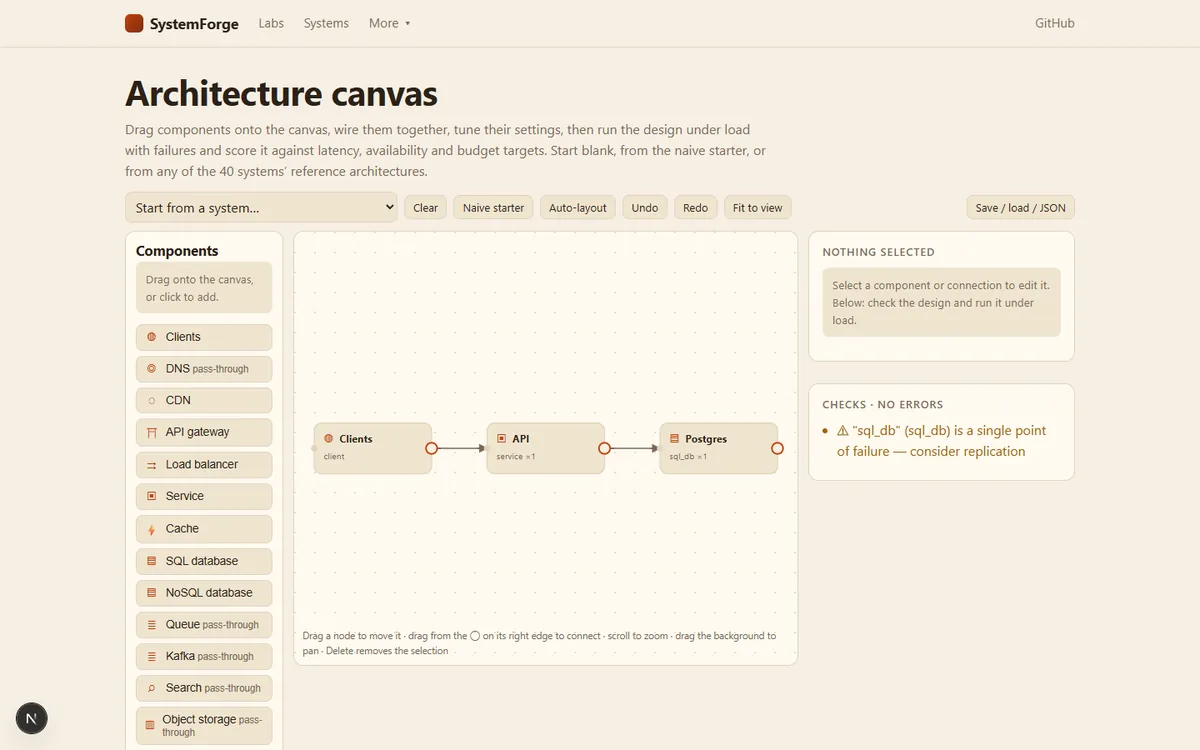
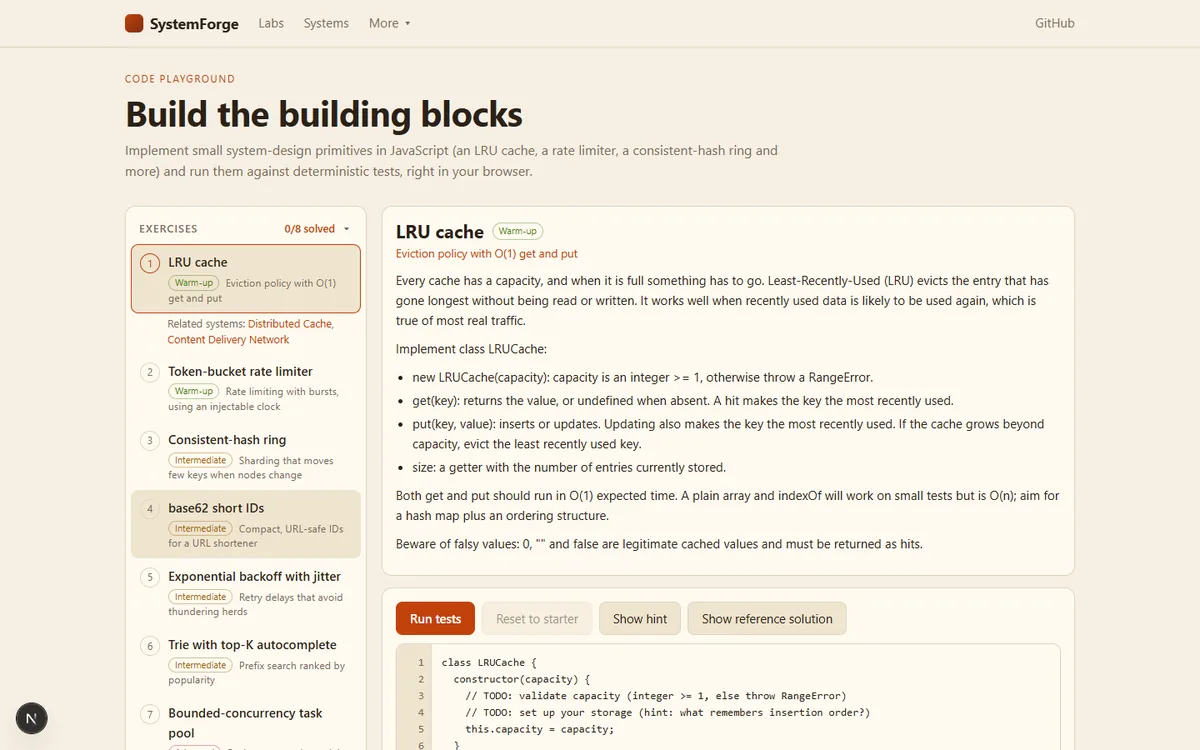
An architecture canvas that reads and writes the architecture JSON and runs it under load, a code playground that runs your JavaScript in a sandboxed Web Worker, a capacity calculator and a timed interview mode.
05
Mini-systems
Three Docker Compose systems with real services, Redis, Postgres and nginx: a URL shortener, ticketing under concurrent buyers and a distributed rate limiter.